

The summers people remember are rarely the ones that cost the most. They are the ones where something ordinary turned into something else entirely, where a regular Tuesday afternoon became the day everyone still talks about ten years later, and the backyard felt like the whole world.
You do not need to buy anything to get those afternoons. What you need is a bit of structure, a few things that happen the same way every year, and water that is ready when someone decides today is the day. Here is how families do it, and the small number of rules that have to sit underneath all of it.
Why the Backyard Pool Is the Best Memory-Making Space You Own
A backyard pool does something a day trip cannot. It removes the friction. Nobody has to be persuaded into the car, nothing has to be booked, and there is no reason a Tuesday cannot become an event. Memory works better with repetition and sensory detail, and a pool delivers both: the same water, the same light coming through the trees at the same hour, and the same handful of people, over and over, across years.
It also puts everyone in the same place with nothing else to do. That is rarer than it used to be, and it is most of the value. If you are planning a pool built around how a family actually uses it, this is the part worth designing for, more than any single feature.
Before the Fun: The Rules That Make Everything Else Possible
This section is short and it is not negotiable. Everything below it is better when these four things are settled, and the whole thing stops being a good idea when they are not.
One adult, watching, with nothing else to do
Not an adult who is also cooking, or on a phone, or half-watching from inside. One person whose only job for that stretch of time is the water, handed over deliberately when they need a break. Drowning is quiet and it is fast, and it does not look like it does in films. In a group of adults, everybody assumes somebody else is watching, which is precisely how it happens.
No breath-holding contests, ever
This is the rule most families have never heard, and it is the one worth knowing. Repeated or competitive breath-holding underwater can cause a blackout with no warning and no struggle, and it happens to strong, confident swimmers in shallow water. Who can stay under longest is not a game. Retrieval games where children surface between each attempt are completely fine, which is why the treasure hunt below is written the way it is.
Feet first, every time
Most residential pools are not built deep enough for head-first diving, and the injuries that result from getting that wrong are life-changing rather than temporary. Set it as an absolute rule rather than a depth judgement, because children are poor judges of depth and worse judges of it when other children are watching. Cannonballs, jumps and running entries from the correct places are all fine, and children prefer them anyway.
The barrier is the backup, not the plan
Supervision is the plan. The barrier is what covers the moments supervision fails, which are the moments that matter, because most young-child drownings happen when nobody thought swimming was happening at all. Texas sets a statewide floor for pool barriers: at least 48 inches high measured from the outside, no gap over 4 inches at the bottom, no opening a 4 inch sphere passes through, and gates that are self-closing and self-latching with the latch out of a child’s reach and the gate swinging away from the pool. Individual cities can and do require more, so check yours. If your barrier does not meet that or the gate has stopped self-latching, a compliant safety fence is the least expensive serious thing you will ever do to a pool. A fitted safety cover adds a second layer for the months the pool is not in use, and a screened enclosure does the same job while keeping the space usable. Boundary fencing for the rest of the yard is a separate question from the pool barrier and does not substitute for it.
Making Ordinary Pool Time Feel Like an Occasion
The difference between swimming and an event is almost entirely framing. It costs nothing and it works on children far better than anything you can buy.
Name your summer traditions
Give the recurring things a name. Not “we might swim later” but Friday Night Float, or Last Light Swim, or whatever your family ends up calling it. A named thing gets anticipated, remembered and asked for. An unnamed thing is just an afternoon.
Build a pool playlist together
Let each person add songs, including the terrible ones. Play it every time. Within one summer that playlist stops being music and becomes a time machine, and in fifteen years it will do more to bring back a specific afternoon than any photograph you take.
Is your pool set up for the way your family actually uses it?
Shallow play areas, lighting for evening swims, a gate that latches properly: some of it is a small job and some of it belongs in a design. We will tell you honestly which is which. Call Clear Blue Pools and Backyards at (214) 253-2052 or tell us what your family needs from the yard, and we will come and look at it.
Six Pool Games for Kids That Cost Nothing and Get Remembered
None of these need equipment beyond what is already in the house. All of them work across a wide age range, which matters when the ages in your pool are five and twelve at the same time.
The underwater treasure hunt
Throw in a handful of sinking objects, coloured rings, coins, anything that will not stain. Children dive down, grab one, and surface. The rule that makes it work: one object per trip, surface every time. Nobody stays under, nobody competes on how long they can hold their breath, and it stays fun. Scoring by colour lets a five year old and a twelve year old play the same game.
Pool Olympics
Six or seven events, invented by the children, run in order, with a scoreboard on the deck. Longest float, best handstand, fastest width, most convincing shark impression. The formality is the fun. Write down who won each year and it becomes a record that gets argued about for a decade.
The float parade
Everyone decorates a float with whatever is in the house, then they process past the judges. Categories should be silly and specific: most likely to sink, best use of a towel, most convincing vehicle. The preparation takes longer than the parade, which is the point.
Night swim film festival
A sheet, a projector, and a swim after dark. It is the single most memorable thing on this list, and it depends entirely on being able to see. That means proper in-pool lighting so the bottom of the pool is visible, not just ambient light on the surface, plus deck lighting and surfaces that make the edges obvious. The watching adult rule matters more at night than at any other time, and headcounts between films are worth doing out loud.
The cannonball championship
Judged on height, sound and splash radius, with entirely subjective scoring and a great deal of arguing about it. This replaces the diving contest for a good reason: cannonballs are feet first, they suit any pool depth, and children genuinely prefer them. Give it a trophy, even a terrible one, and it will run for years.
The pool treasure box
A waterproof box on the deck. Anyone can put something in it: a note, a drawing, a ticket, a shell. It gets opened on the last swim of the summer and read out. It takes no effort during the season and turns into the best fifteen minutes of the year.
Traditions That Compound Year After Year
The single-afternoon activities above are good. The ones that repeat on the same date every year are better, because the anticipation does half the work.
First day of summer swim
The same date every year, whatever the weather is doing. It marks the season and it is the thing children start counting down to in April.
Last pool day
A deliberate ending, with the treasure box opened and a photograph taken in the same spot every year. Endings are what fix a season in memory. Without one, summer just stops. If a heated spillover spa is part of the pool, the last pool day moves considerably later in the year, which is one of the better arguments for having one. You can add one to a pool you already have if it was not built in originally.
The photo wall
The same photograph, same position, same people, every year. Ten frames in a row on a hallway wall is the most affecting thing in this entire article, and it takes thirty seconds a year to build.
The Pool Features That Make Family Summers Easier
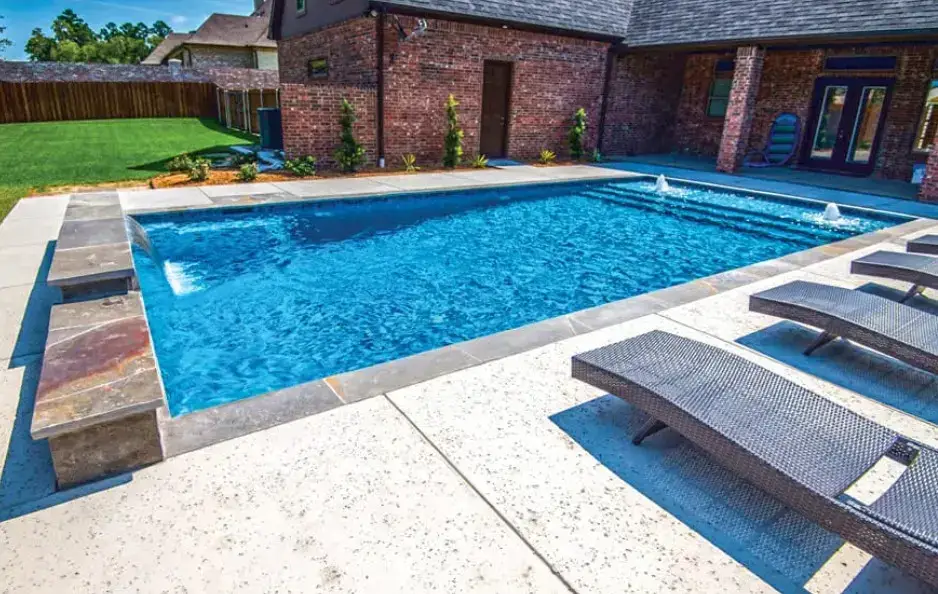
None of the above requires a particular kind of pool. Some of it is easier with one. A shallow shelf added to the design, a sun shelf or tanning ledge, is the feature that changes family use most: small children can play standing up, adults can sit in the water with them, and it is the easiest place in the pool to supervise from. It is structural, so it belongs in the plan rather than in a later phase. If the pool is already built, updating an older family pool covers most of what can still be done.
Two more that matter more than they sound. Resurfacing a rough pool interior is worth doing purely for children’s feet, because old plaster gets sharp. And a deck that is not painful to walk on in July decides whether anyone lingers outside the water, which is where most of the talking happens. Shade over the seating area does the same job for the adults, and a fire pit for the end of the evening keeps everyone outside for another hour after the swimming has finished. There is more on how these choices fit together in our piece on choosing a pool shape around how you live.
Keeping the Pool Ready for a Spontaneous Tuesday
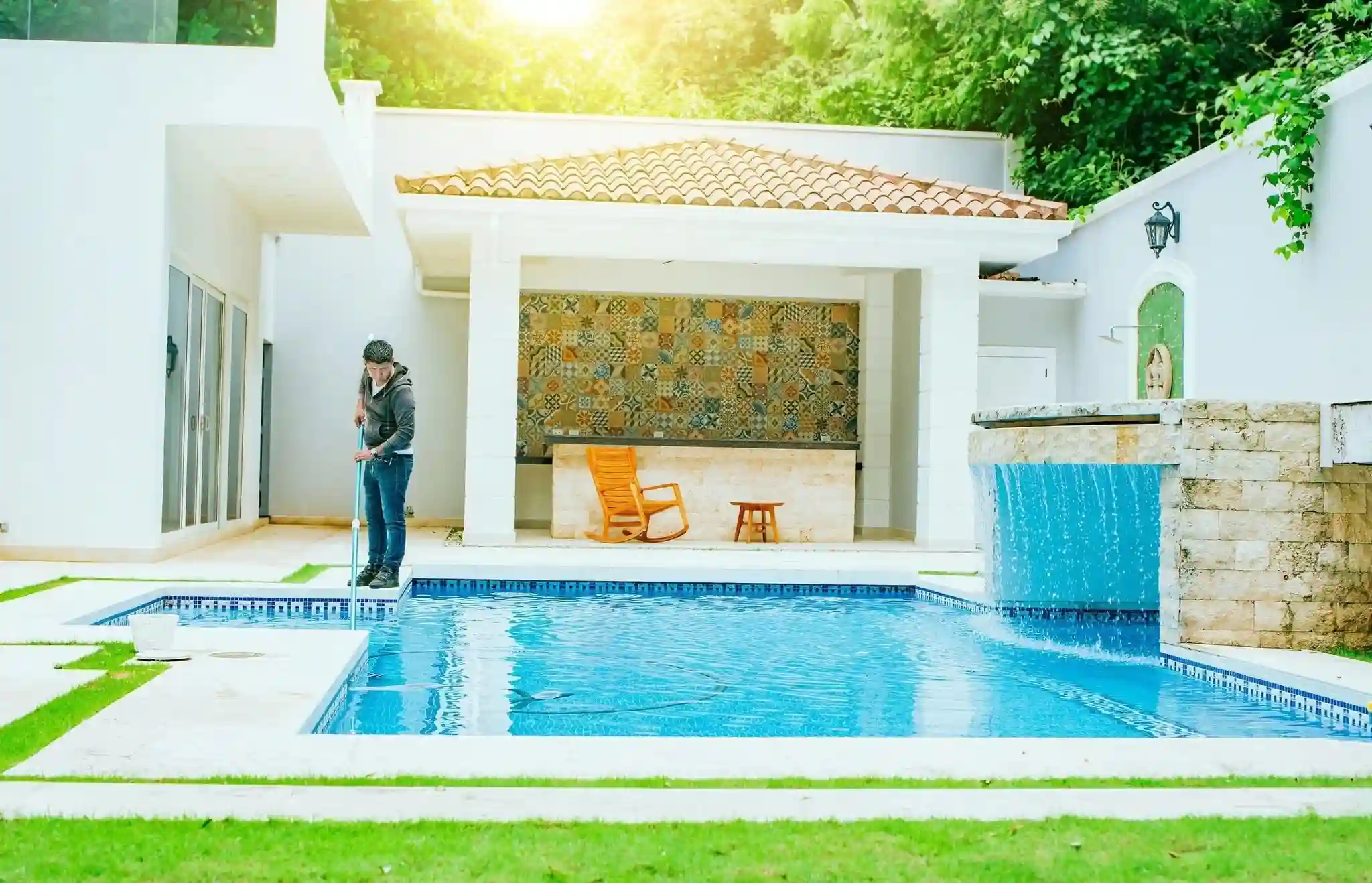
None of this works if the answer to “can we swim” is “not today”. In a North Texas summer that takes more attention than most people expect, because sunlight strips chlorine out of the water far faster here than the label on the bucket assumes. The short version is to test more often than feels necessary, add sanitizer in the evening rather than the middle of the day, and treat a pool that has had a lot of people in it differently from one that has not. The longer version, including why it happens and what to do when the readings stop making sense, is in why Texas sun is so hard on pool water.
If that is more attention than you want to give it during the months you would rather be using the pool, you can hand the chemistry to us and have it looked after weekly. Switching to salt makes the water gentler on eyes and swimsuits, controls that put the whole system on a schedule remove most of the remembering, and if it is taking longer every year to keep up, the problem is usually the pumps and filters keeping up rather than anything you are doing wrong.
A Note for North Texas Families
Two things are specific to here. The first is that the season is long, roughly May to September for comfortable swimming, which means traditions built around a first and last swim have real distance between them and genuinely feel like bookends. The second is that barrier requirements are set locally on top of the state minimum, so what is required in Keller is not necessarily what is required in Frisco or Mansfield. If you are unsure what applies to your address, ask your city before you assume an existing fence is compliant. We build across every town we cover from North Richland Hills, and we can tell you what your city expects.
If you want to see the kind of pools these afternoons happen in, pools we have built for families is the place to start, what other families say covers what working with us is like, and there are ways to spread the cost if the timing matters more than the total.

Frequently Asked Questions
What are the best free pool games for kids of different ages?
Games that score on something other than speed work best across a wide age range. Colour-based treasure hunts, float parades judged on silly categories, and cannonball contests judged on splash all let a five year old and a twelve year old compete in the same game. Anything scored purely on speed or strength stops being fun for the younger child within about ten minutes.
Is it safe to let children play breath-holding games in the pool?
No, and this is the one rule worth being absolute about. Repeated or competitive breath-holding can cause a blackout with no warning, and it happens to strong swimmers in shallow water. Retrieval games where children surface after each attempt are fine. Contests over who can stay under longest are not.
Can children dive into a backyard pool?
Most residential pools are not deep enough for head-first diving, and the consequences of misjudging it are permanent. The simplest approach is a blanket feet-first rule rather than a depth-by-depth judgement, since children judge depth poorly, especially in front of other children. Cannonballs and jumps from the right places are fine.
What does a compliant pool barrier need in Texas?
The statewide floor is a barrier at least 48 inches high measured from the outside, no gap greater than 4 inches at the bottom, no opening that a 4 inch sphere passes through, and a self-closing, self-latching gate with the latch out of a child’s reach that swings away from the pool. Individual cities set stricter rules, so confirm with your municipality. If your gate has stopped latching on its own, treat that as urgent rather than a maintenance item.
How do I keep the pool ready for spontaneous family use all summer?
Test more often than feels necessary, add sanitizer in the evening rather than at midday, and treat the pool differently after a day with a lot of swimmers in it. Texas sun burns through chlorine much faster than most guidance assumes. If that is more upkeep than you want during the months you would rather be swimming, weekly service takes it off your hands entirely.
Can you add a shallow shelf or lighting to a pool we already have?
Lighting, yes, and it is one of the better-value upgrades for family use because it turns evenings into usable pool time. A shallow shelf is structural, so adding one to an existing pool is a bigger job than adding one during a build, though it is often possible as part of a wider remodel. Call (214) 253-2052 and we will tell you what your pool will take.
The pool is the easy part. What your family does with it is the bit worth planning.
We build and upgrade pools for families across North Richland Hills and the DFW area, and the questions worth asking early are the ones about how the space will actually be used, not which features sound impressive. Call Clear Blue Pools and Backyards at (214) 253-2052 or get in touch and we will come and look, and we will put a free 3D design in front of you before anything is committed to.