

Most homeowners call us with a shape and a budget in mind. Almost nobody calls with a question about their dirt, and that is the one that decides the most. If you are weighing a concrete vs fiberglass pool in Texas, and specifically in Dallas Fort Worth, the ground in your backyard should settle it long before price or looks do. We build custom concrete pools with structural steel, so you know where we stand. Fiberglass still wins in some yards.
The three kinds of pool sold in Dallas Fort Worth
- Concrete. Also sold as concrete, meaning concrete sprayed under pressure over a cage of steel bar, formed in your yard.
- Fiberglass. A single piece shell molded at a factory and craned over your fence, usually sold by a dealer working from one manufacturer’s catalog of molds.
- Vinyl liner. Steel or polymer wall panels with a liner stretched inside. Common in the Midwest, rare here.
What expansive clay actually does across a North Texas year
Our soil is not stable ground. Much of the Dallas side, and a good stretch of eastern Tarrant County, sits on Blackland Prairie clay. The signature soil there is Houston Black, the official state soil of Texas and one of the Vertisols, a soil family that visibly changes volume with moisture.
The cycle repeats every year. Spring rain soaks in, the clay swells and pushes up and out on anything sitting in it. Then August arrives, the rain stops, the clay gives that water back to the sky and shrinks, and deep cracks open across the yard. You have seen neighbors running soaker hoses around their slab foundation in the heat. That is the same soil doing to their house what it does to a pool.
Drive west and the story changes. Out toward Aledo and Weatherford you are in the Cross Timbers, where sandier loam over sandstone and limestone drains faster and moves far less. That is why a builder should not give the same answer in Sachse and Aledo.
The real concrete vs fiberglass pool question in Texas is engineering, not material
A well engineered pool of either type beats a badly engineered pool of the other. The first question is not material, it is whether anyone looked at your soil, designed the shell for what they found, and made a plan for water. A builder who shrugs at that is telling you how the rest of the job will go, and we cover more warning signs in our guide to hiring a custom pool builder in Dallas Fort Worth.
Concrete: a steel reinforced shell built for ground that moves
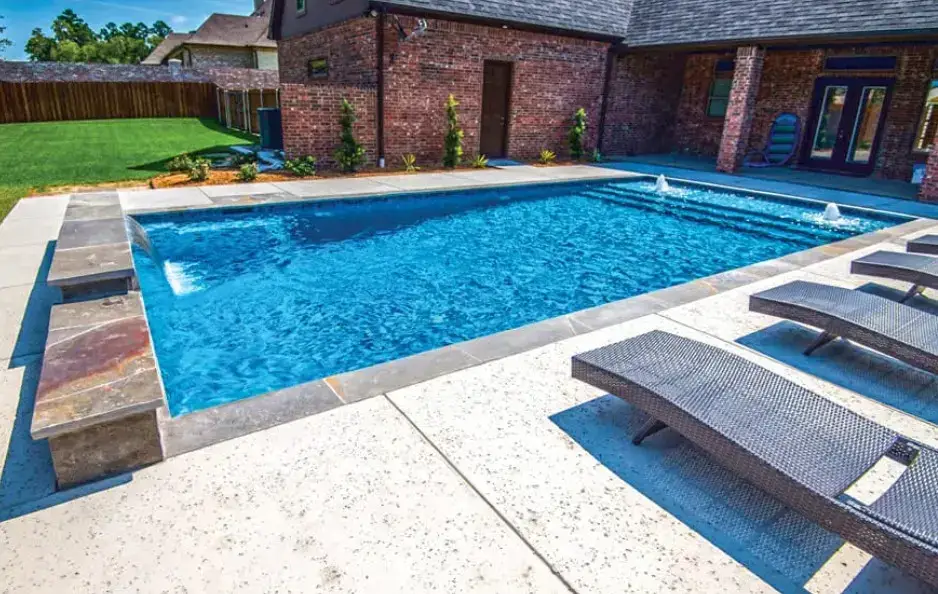
This is what we build, so read it with that in mind. A concrete pool is placed as one continuous structure around a grid of steel bar, locked into a thick bond beam at the top. It works as a single rigid unit, and steel and thickness can be increased where the soil calls for it. On a reactive Blackland lot that matters, because the fix for difficult soil is more steel, deeper footings and drainage, not a different shell.
Concrete is also repairable, patched and refinished decades later without replacing the pool. The full build sequence, including the permitting and approvals we handle, is on our new pool construction page.
Fiberglass: the real advantages, and the two conditions that cause trouble here
Fiberglass genuinely wins on several things, and a builder who says otherwise is selling, not advising.
- It goes in fast, since the shell arrives finished.
- The gelcoat is smooth and non porous, so it holds fewer algae, and no plaster clock ticks toward a resurface.
- On stable, well drained ground it is an excellent pool.
Two local conditions cause the trouble. The first is backfill, because a fiberglass shell does not carry the soil load on its own, the material packed around it does. Done right, that is clean gravel compacted in lifts. Done cheaply, it is the same expansive clay from the hole, shoveled back in to swell against the shell every spring. The second is water, the bigger risk of the two, and it gets the next section.
Hydrostatic pressure, high water tables and lots near the lakes
Groundwater pushes up on an empty pool the way water pushes up on a boat. That is hydrostatic pressure, the most underrated risk here. It matters most in the Trinity River bottoms and on low ground near Lake Grapevine, Eagle Mountain Lake and Joe Pool Lake, where the water table sits high after a wet spring.
A light one piece shell sitting empty in saturated ground is exactly what water likes to float, which is why fiberglass comes back to water as much as to soil. Concrete is heavier, but no shell is immune. What protects either one is a hydrostatic relief valve, real drainage and, on some lots, dewatering during the dig. Never drain your own pool in a wet season without asking your builder.
Vinyl liner: why you rarely see one in this metro
The same soil and water math explains the third option. Vinyl is the cheapest of the three and nearly absent from DFW backyards. Our heat is hard on a liner, panels sitting in reactive clay can go out of plumb, and the liner is a wear item you will be quoted to replace. When the cheap option does not sell in a market this size, that is your answer.
Shape, depth, tanning ledges and features
Fiberglass shapes come from a manufacturer’s molds, capped by what a truck can legally haul, which limits width and depth. If your lot is an odd shape, or the design calls for a raised spa, a vanishing edge or a wide tanning ledge, concrete is the only one of the three that will do it, and it can follow a sloped Keller or Southlake lot rather than fight it.
Year 12: what repair and resurfacing look like
- Concrete. The finish is the wear layer, not the structure, and replastering and resurfacing are two names for the same job. Plaster is classic and smooth, most affordable with the shortest life. Aggregate blends stone or quartz through it, tougher and better at hiding staining. Pebble is the most durable, longest lasting and widest in color.
- Fiberglass. Nothing to resurface on a schedule, but gelcoat can fade in Texas sun and spider crack, and repair is a specialist job with a color match that rarely disappears.
- Vinyl. Liner replacement is a known, repeating cost.
The deck almost always tells you first
Whatever shell you pick, the concrete around the pool is thinner and sits right in the reactive layer, so it moves before the shell does. Telling a cosmetic crack from one that means the slab has to come out is its own subject, and we cover it in how to read a pool deck crack in North Texas. Read how we approach pool decking before you compare bids, because deck detail is where cheap quotes hide.
How to ask any builder the right soil questions
- What is the soil on my lot, and how did you determine that?
- Is a soil report part of this proposal, or an extra?
- How does the design change on reactive clay versus sandier ground?
- What are you backfilling with, and how is it compacted?
- Is there a hydrostatic relief valve, and how are you handling groundwater?
- Exactly what does the warranty cover, and for how long?
Take these to every bid, ours included, and get answers in writing. Our own work carries a one year craftsmanship warranty, and we are licensed and insured, BBB Accredited, a PebbleTec Elite Builder building with Pentair equipment.
Frequently asked questions
Is fiberglass ever the better choice in North Texas?
Yes. On stable, well drained ground, with a catalog shape that suits your yard and gravel backfill compacted properly, fiberglass is a good pool. It gets harder to defend on heavy Blackland clay, on a lot with a high water table, or when the design needs a shape no mold offers.
Will a concrete pool crack in expansive clay?
Concrete can crack, which is exactly why the steel is there. A shell reinforced with structural steel acts as one rigid unit so the ground moves around it rather than pulling it apart, with the engineering matched to your lot.
How long does a pool build take in Dallas Fort Worth?
Most of our builds run four to eight weeks depending on complexity, site conditions and features. Permitting and approvals are part of what we handle, and timelines vary across the 12 cities and 7 counties we serve from our North Richland Hills base.
Get a design that starts with your soil
Do not settle this from a brochure. Tell us where your lot is, we will tell you what we expect to find under it, and we will design around it. Get in touch for a free design consultation and quote, or call (214) 253-2052.